Podcasting (English Version)
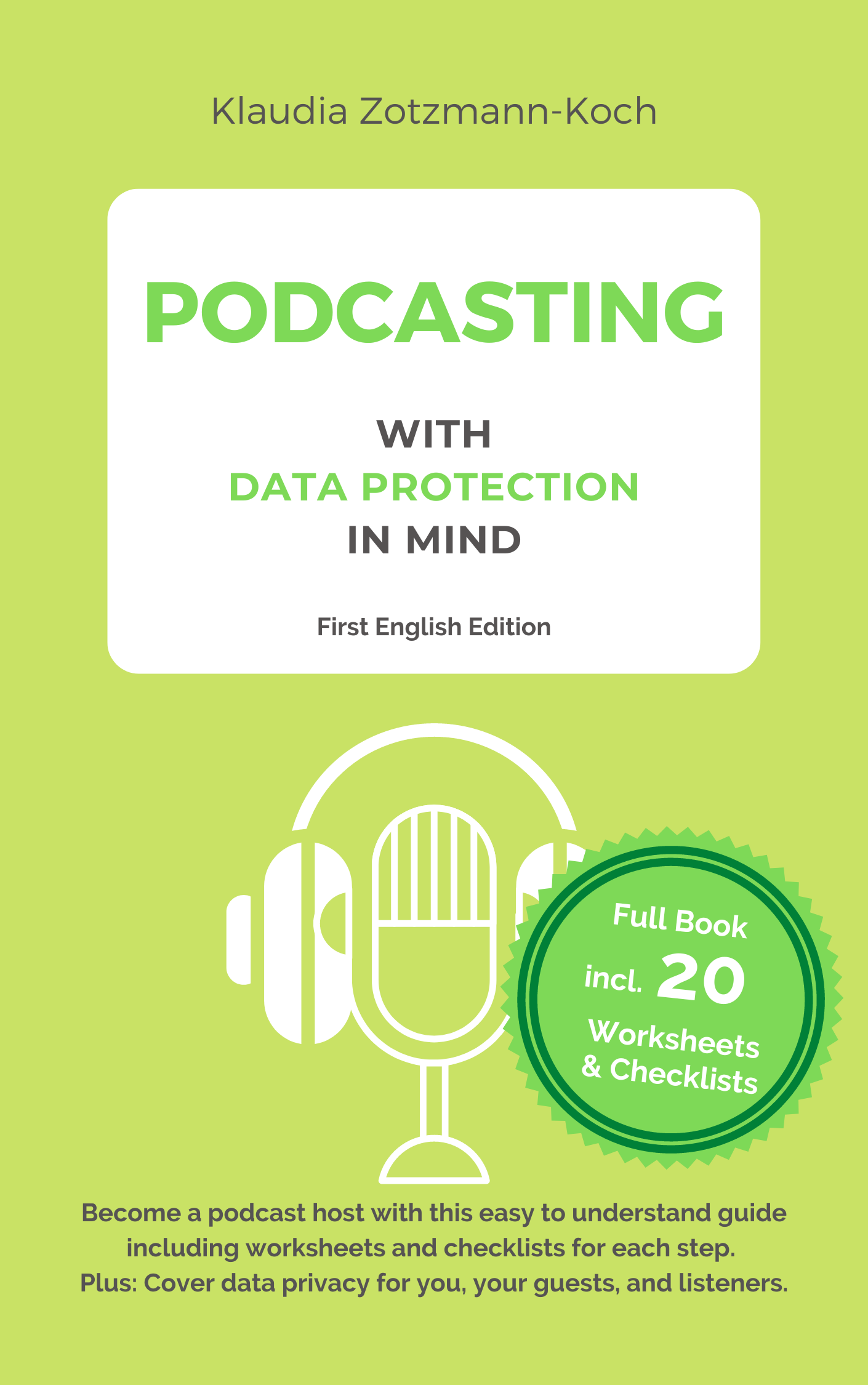
This book is your guide to your first podcast. Inside you will find everything you need to know: what hardware and software are essential? What about data protection and other legal requirements for podcasts? And finally: How do you get your podcast into the hearts of your listeners? Easy to understand and with many practical tips from start to finish.
Klaudia Zotzmann-Koch has been a podcast listener since winter 2005/2006 and has been an active podcast host herself since 2016. She has four shows of her own, is a regular on another, and has been a guest on many other podcasts. Here, a podcaster writes for aspiring podcasters.
Start reading
About you
This book is written for people who simply want to host a podcast and embrace creatively. Some readers may be self-employed in the creative field: authors, musicians, goldsmiths, photographers, artists, dancers, filmmakers and all those who want to build a (further) communication channel to their fans, customers, readers and listeners while having fun and creativity in mind. Some may want to create a perhaps completely new communication basis. For them, I put in the tips on the legally compliant implementation of their podcast in business. But the book is also for people who want to start a podcast about their creative hobby or a podcast as a creative hobby.
This book is NOT written for marketers who are only looking at sales numbers and want to see money flowing through a podcast. If you are one of those people who gets high on comparative analytics graphs and monetization, please put this book down immediately. It's not for you.
About Me
Hello, my name is Klaudia Zotzmann-Koch. I'm an author, podcast host, data privacy expert and an avid podcast listener since winter 2005/2006. I remember very well sitting in my old apartment… It was a damn cold winter; the coldest I've ever experienced in Vienna. So cold that the cat was voluntarily sleeping under the bedsheet. That's when I downloaded and listened to my first podcast episodes. Among them was the literaturcafe.de podcast.
I have been a podcast host myself since fall 2016. The idea matured for a long time. It was during the speaker training (for better readings) when it finally »clicked» and the idea was clear as daylight: I wanted to host my own podcast. In the meantime, I have four podcasts of my own (all of them mostly in German: ViennaWriter's Podcast, Der Datenschutz Podcast, Desperate Househackers and Schreibtischgespräche). And I am part of the Sendegarten team, which is a regular meta-podcast about the podcast world. I coach and give workshops in all of my areas: creative writing, digital self-defense, and podcasting.
This book is a compilation of my experiences and the things I have learned from the questions and contributions of the participants of my workshops.
In the first part, I answer the most burning questions and then follow more detailed explanations from finding your topic to technology and the publication and distribution of a podcast. The book is meant to be a guide and does not claim to be complete.
There are a variety of paths that lead to your own podcast. In fact, there are probably as many ways as active podcasters in the world. And so much different technical equipment that one can get dizzy during the research. Spoiler: For a start you don’t need anything but your smartphone. In this book is a small selection, knowing that I will never be able to cover everything. So you won't be able to avoid doing some research yourself and ultimately finding your own personal way for your own podcast.
Chapter 1: Pod-What?
Why do podcasts keep trending? The format is not new; after all, they've been around since the early 2000s, and in the German-speaking world, too, we have podcasters from the very beginning. Tim Pritlove tweeted in April 2020:
»Just did a rough count of how many podcasts I've banged out in the nearly 14.5 years since I started and come up with about 1.8 shows per week.«
Tim Pritlove, April 2020
Original German Quote: »Gerade mal grob überschlagen, wie viele Podcasts ich in den knapp 14,5 Jahren seit Beginn rausgehauen habe und komme auf ungefähr 1,8 Sendungen pro Woche.« (Tim Pritlove, April 2020)
And he still publishes podcast episodes with enthusiasm, and many others with him. Meanwhile, countless media companies are also releasing audio formats, and more and more celebrities and marketing departments are discovering the medium. Many more people listen to podcasts every day. But why? The short version is: it's the intimacy, the closeness between podcasters and listeners.
The majority of all podcast consumers listen with headphones. There are figures floating around from 70 to over 90 percent, depending on the study or source used. This means that as podcasters we are very close to the ears of our listeners. It doesn't get any more intimate than that. Even authors whose books people take to bed don't get that close. So podcasts are the most intimate communication channel we can have.
A podcast thrives on building trust through this intimacy. So, if you see your podcast as a pure marketing tool and are looking for sales figures and monetization, you can put this book down right away, because I take a different approach, that even goes beyond classic content marketing.
Through your voice, your listeners know exactly whether you mean what you say or not. Whether you stand behind what you say or not. Our voice reveals a lot about us, much more than the pure content we say. When a relative of yours calls, or a good friend, you know in the first three seconds how the person is doing, if she is okay. And it's the same with our podcast listeners.
Being there for your listeners is key.
There are listeners who are purely interested in information. And if you are aiming exclusively at knowledge transfer, this will probably also make up the majority of your future listeners. But there is also a vast number of podcast listeners who like to be with you. It's like they're sitting next to you in your workroom, workshop or studio, being the fly on the wall. They also like to follow your development. That means you can start your podcast where you are right now. Not everything has to be perfect. You don't have intro music yet? It doesn't matter. You only have ideas for the first few episodes and no idea who to invite as a guest in episode seven? Doesn't matter. What many podcast listeners also like is to interact with their favorite podcast hosts. Just ask your listeners what interests them. Ask them and your first guests for a recommendation who to interview next.
Your path as a podcast host starts here.
If you would like to build up a (further) communication channel to your fans, customers or readers, whom you may already have, with fun and creativity and create a perhaps completely new communication basis, then I am happy to accompany you on your first steps into the podcast world on the other side of the microphone.
What is a podcast and what is it not?
The word »podcast» comes from »iPod» and »broadcast» and is actually an Apple invention. In the early 2000s, when new podcast episodes were available, they were downloaded to one's own computer and transferred to an MP3 player via cable. Some people still do this today, for example for sports, when they prefer to take a small MP3 player with them instead of the smartphone, which is usually quite large. According to studies, however, the majority of all podcast listeners actually listen to podcasts on their smartphones.
Speaking of studies, a very well known and much cited German study is the »Spot-On Podcast Studie« from 2017/2018. You can find the link at the end of the book.
A podcast is an audio format available on the internet. A podcast consists of a number of episodes.
A podcast includes the following essential components:
- the actual audio file (usually .mp3)
- the RSS feed that is the bridge to the listeners
- the show notes, i.e. additional information that supplement the audio format and, for example, make links accessible to the listeners with a click or touch
- chapter markers that make it easy for listeners to browse longer episodes, share content, and reference it in blog posts or articles, for example.
- some metadata, i.e. additional information about the podcast, such as the year of publication or also under which license the content was published (in Europe usually a Creative Commons license)
What a podcast is NOT.
For me and many people in the podcasting community, podcasts are not formats that take place behind closed doors. For a real podcast, it is essential that it is freely available on the web for all people. If a format is only available on a platform for which you need at least an own login or even a paid subscription to listen to the content, the formats offered are not free on the net and therefore not a podcast. They are audio formats on the web, but for a very limited target group; namely those who have an account for this one platform.
Some people additionally submit their inherently free podcasts to such »ring-fenced» platforms as TuneIn, Stitcher, Spotify, or Deezer in order to reach people who have accounts there.
I too had once submitted my podcasts to Spotify, TuneIn and Stitcher and thus had them listed within their offerings, but have withdrawn the submissions because I don't want to continue supporting these business models. After all, why should these companies make money from content that is available for free? After all, their customers pay the companies money to listen to my free content via their platform. By the way, I and other people who submit their podcast feeds to such companies don't get any money for it. You would have to sign an exclusive contract with one of these companies and the podcast would then be available exclusively to them behind the login and paywall. The more content disappears behind such payment barriers, the emptier the free web becomes. That's why I decided against it quite a while ago and that's why mine - as well as many other podcasts from the podcasting community - are only available for free on the net but not via Spotify.
How do the podcasts get to the listeners?
Via the RSS feed. Just as with blogs - the older ones will remember. Blogs are also free formats on the web and can be read by anyone, with the exception of a few very private blogs that are only available to family members or wedding guests, for example.
The RSS feed is the magic behind the podcast system. For large platforms as well as for free podcasts. »RSS« stands for »rich site summary« or, more colloquially, »real simple syndication«. It's a file format that displays changes on websites like news sites or blogs. Don't panic, you don't have to write the RSS feed by hand. A little later, I'll show you how to create the RSS feed, depending on the system you use. Podcasting itself is also a lot easier than it might sound when you first read all the information. Yes, some technology is necessary, but at the latest when you get started, the bulky terms become simple workflows that you will soon have internalized.
As with blogs, when you publish a new podcast episode, a new entry is displayed via the feed. Most listeners use their smartphones to listen. There are so-called podcatcher apps. First and foremost is Apple's own Podcasts app. But there are a number of other apps that allow you to subscribe to podcasts. Also on Android; AntennaPod for example. And on the free open-source app store fdroid you can find free and data protection aware podcatcher apps.
Subscription, by the way, has nothing to do with a newspaper subscription, but means that you »watch» a feed and get notified when there is a new episode available. Depending on the app's settings, new episodes are downloaded immediately or only when you actively initiate the download.
The RSS feed makes it possible to reach your audience directly. But even more! One can also submit this feed to various podcast catalogs. Again, Apple, as the inventor of podcasts, is ahead of the game. iTunes is the largest podcast directory on the market. However, there are more. Podcatcher apps access these catalogs and people don't have to gather the feeds of various podcasts manually on the net, but get the podcasts delivered directly to the podcatcher app and only have to click once to subscribe to this podcast, i.e. listen to upcoming episodes.
In all Podcatcher apps it is possible to add a feed by hand. This can be useful if a podcast is not available in the catalog accessed by the listener's podcatcher app. And some podcast feeds like podcasts for Patreon supporters or such are actually not publicly listed. But by manual adding, you can listen to them within your usual podcatcher app.
So RSS feeds are at the heart of how podcasts technically work. A real podcast always has an RSS feed.
Podcast types
Maybe you already listen to some podcasts yourself and know the following types of podcasts. Maybe you're also wondering about some of them: Wait, that's possible? And yes, podcasts are as diverse as the people who produce them.
A very common format is the talk podcast. In German we have a very colloquial word for those: »Laberpodcast«, which deepL offers to translate as »babble podcast«. The format is easy: people talk to each other. Often for hours. And yes, these formats do have a large audience. Remember: It's all about being in the room with the podcasters. People like the feeling of being part of the conversation and listening like the fly on the wall. Some talk podcasts also take place as live broadcasts with a chat. This allows listeners to actively chat, interact, and comment amongst each other and with the podcasters. A great dynamic can develop here when listeners write live questions in the chat, the podcasters respond directly and a dialog develops between written and read questions and freely spoken answers.
Podcasts on specific topics are also very popular and might also be interesting for you if you are not yet sure where your podcast journey should go. As the name suggests, it's about a specific topic that runs through all the episodes. The format of the individual episodes can also change - from interviews with experts to talk episodes with colleagues to solo episodes with tips and tricks, recordings of panel discussions at events, etc..
Personality podcasts are about one person. That's something for the more extroverted podcasters who seek the limelight talking about themselves. For example, author and activist Cory Doctorow's podcast is a mix of all his novellas read by himself, alternating with recordings of talk shows and interviews he's been a guest on, announcements of his tour dates, and so on.
Interview podcasts - the name says it all. Interviews with people either broadly from one area or roughly on one topic. It's sort of a topic podcast reduced to one format. There is, for example, The Creative Penn Podcast by Joanna Penn, who publishes an interview every week with someone from the literary world or publishing industry. While she specializes in self-publishing, her guests are slightly wider spread. They are not only authors, but also people who have built entire companies and business models around publishing books.
Fiction podcasts also exist. People read fictional stories or perform audio plays. If you're an author, maybe that would be an interesting format for you? There are also author podcasts where they read shorter works of themselves every now and then for one or more episodes, like Cory Doctorow's podcast which I mentioned above, though only some of his episodes are »fiction.» Fiction podcasts can also be part of topic- or personality podcasts.
There are DIY podcasts in which during the recording something is done, such as wool spun, something tinkered or repaired, cooked, etc. and incidentally it is explained what and how and what works easily and which problems arise. Waiting times are filled with interesting information about the history of this specific dyeing method, etc.. The conversation usually becomes quite nerdy. Yes, this also works and finds listeners. Many even. Some examples from the German podcast sphere are my little podcast Desperate Househackers on everything you can do yourself, the Hobbykoch (hobby cook) podcast or Zeitspeise (time dish), a podcast about historical dishes. They inspire extremely large listenerships.
There are also science podcasts for which the German speaking community comes together at wisspod.de. With »ganzOhr» (»all ears«) there is also an annual conference for them.
And then there are corporate podcasts, coaching podcasts, journalistic podcast formats, public service as well as educational podcasts and certainly a whole lot more that I haven't mentioned.
As you can see, the range is wide. And that's also what makes Podcastland so interesting and varied: no two podcasts are alike. And that's a good thing.
Your podcast, your creativity, your rules.